Focus
Understanding Your Brain: What Happens in Our Brains When We Learn?
StudyMates TeamJul 7, 2026
Learning changes your brain by creating new neural connections, strengthening memory, and improving cognitive abilities through neuroplasticity. This article explains how the brain processes information, forms memories, and why sleep, exercise, and effective study techniques like active recall and spaced repetition help you learn more efficiently.
Learning is one of the most fascinating abilities of the human brain. From learning how to walk as a child to mastering a new language or skill as an adult, our brains constantly adapt and grow. But have you ever wondered what actually happens inside your brain when you learn something new? Understanding the science of learning can help us study more effectively, improve memory, and develop better habits for lifelong growth. In this article, we will explore how the brain processes information, forms memories, and changes through learning.
The Brain: The Command Center of Learning
The human brain is an incredibly complex organ made up of approximately 86 billion neurons. Neurons are specialized cells that communicate with one another through electrical and chemical signals. These connections allow us to think, feel, remember, and learn.Different areas of the brain play unique roles in learning:Hippocampus: Responsible for forming new memories.Prefrontal Cortex: Helps with decision-making, problem-solving, and attention.Cerebellum: Involved in motor skills and coordination.Amygdala: Processes emotions, which can influence learning and memory.
Together, these regions work as a team to process new information and store it for future use.
What Happens When We Learn Something New?
Learning begins when we encounter new information through reading, listening, observing, or experiencing something. Here’s what happens step by step:1. Information Enters Through the Senses
Everything we learn starts with sensory input. Our eyes, ears, skin, nose, and tongue gather information from the environment and send signals to the brain.For example, when reading a book, your eyes capture words and send visual information to the brain for processing.2. The Brain Processes Information
Once information reaches the brain, different regions analyze and interpret it. The brain compares new information with existing knowledge to understand its meaning.If the information seems important or interesting, the brain pays more attention to it.3. Neurons Form New Connections
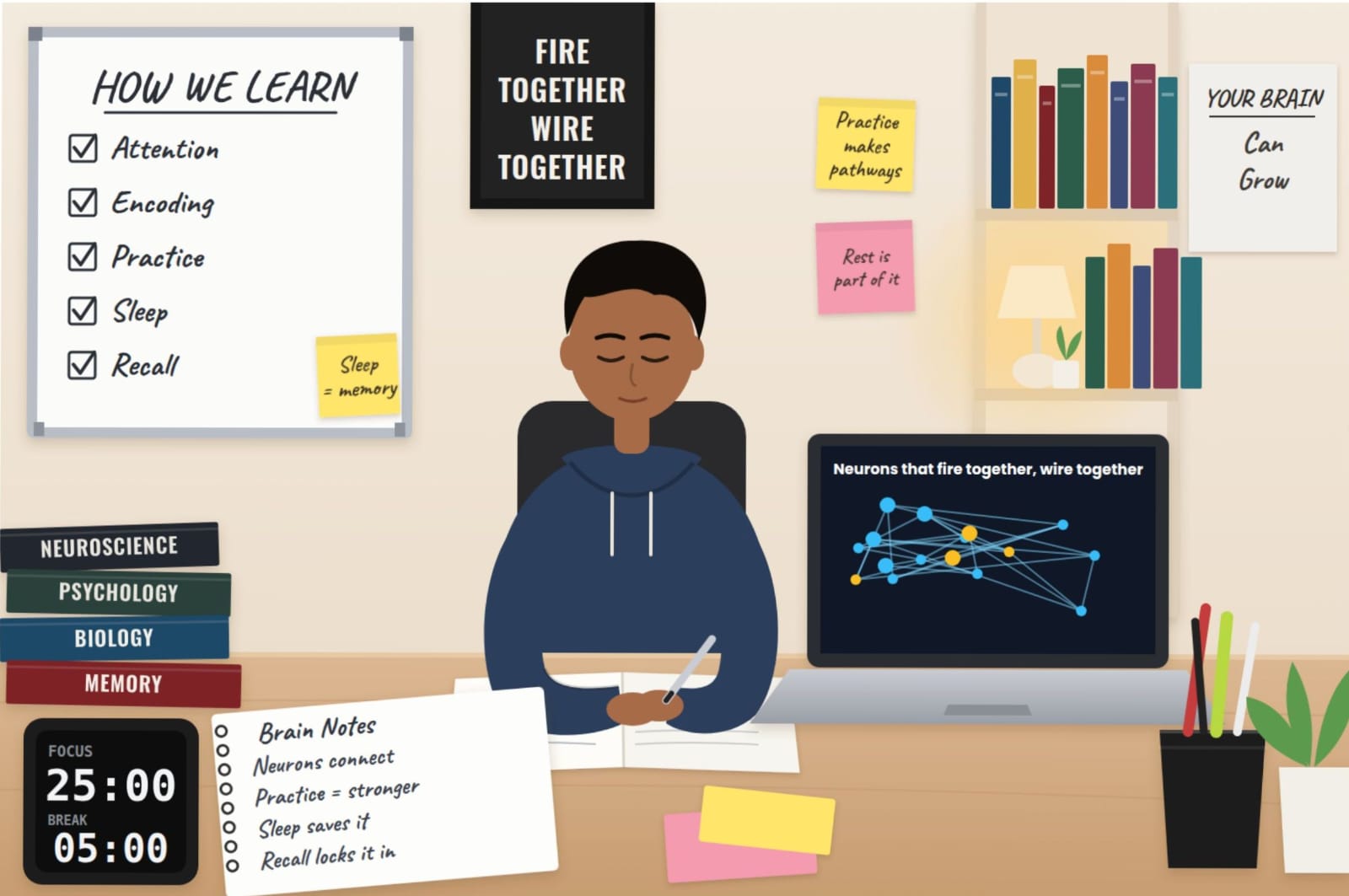
Learning creates or strengthens connections between neurons, known as synapses. The more frequently we practice or review information, the stronger these neural connections become.This process is often summarized by the phrase:"Neurons that fire together, wire together."Repeated learning helps build stronger pathways, making it easier to recall information later.Neuroplasticity: The Brain’s Superpower
One of the most remarkable discoveries in neuroscience is neuroplasticity—the brain's ability to change and reorganize itself throughout life.In the past, scientists believed the brain stopped developing after childhood. Today, research shows that our brains continue adapting and creating new neural pathways even in adulthood.Neuroplasticity allows us to:Learn new skillsRecover from injuriesAdapt to new environmentsImprove memory and cognitive abilitiesThis means it is never too late to learn something new.read this is also:- read this also:- Why Focus Rooms Help You Study LongerHow Memory Is Formed
Learning and memory are closely connected. Without memory, learning would not be possible.Memory formation generally occurs in three stages:1.Encoding
The brain converts information into a form it can process and store.2. Storage
Information is stored in different parts of the brain for short-term or long-term use.3. Retrieval
The brain accesses stored information when needed.The hippocampus plays a major role in transferring information from short-term memory to long-term memory.Why Repetition Improves Learning
Have you noticed that repeating information helps you remember it better? This happens because repetition strengthens neural pathways. When we repeatedly practice a skill or review information, synaptic connections become stronger. Recall becomes faster. Knowledge moves into long-term memory. Techniques like spaced repetition and active recall are highly effective because they encourage the brain to strengthen these connections over time.
The Role of Sleep in LearningSleep is not just for rest—it is essential for learning and memory consolidation. During sleep, the brain: Organizes information learned during the day, strengthens important memories, removes unnecessary information, repairs brain cells. Studies show that students who get enough sleep often perform better academically than those who stay awake studying all night. Getting 7–9 hours of quality sleep can significantly improve learning efficiency. How Emotions Affect Learning
Emotions play a powerful role in how we learn. Positive emotions such as curiosity, excitement, and motivation improve attention and memory formation. On the other hand, stress and anxiety can interfere with learning by affecting the hippocampus.Creating a positive learning environment helps the brain absorb information more effectively. Exercise and Brain Health
Physical activity benefits not only the body but also the brain.Exercise increases blood flow to the brain and stimulates the release of chemicals that support neuron growth and communication.Regular exercise can:Improve concentrationEnhance memoryReduce stressSupport overall cognitive healthEven a short walk can boost brain function and improve learning ability.
Tips to Learn More Effectively
Understanding how the brain learns allows us to study smarter. Here are some science-backed strategies:1. Use Active Recall. Test yourself instead of simply rereading notes.
2. Practice Spaced Repetition: Review material over time rather than cramming.
3. Get Enough Sleep. Sleep helps consolidate memories.
4. Stay Physically Active Exercise supports brain health.
5. Eliminate Distractions. Focused attention improves learning efficiency.
6. Teach Others. Explaining concepts strengthens understanding
Conclusion

Learning is a dynamic process that changes the structure and function of the brain. Every time we learn something new, neurons form connections, memories are created, and the brain adapts through neuroplasticity.Understanding how our brains work can help us become better learners and unlock our full potential. Whether you're a student, professional, or lifelong learner, remember that your brain is constantly evolving—and with the right habits, it can continue to grow throughout your life.
Frequently Asked Questions (FAQs)
1. What happens in the brain during learning? During learning, neurons communicate and form new connections called synapses, helping store and process information.2. What is neuroplasticity? Neuroplasticity is the brain’s ability to reorganize itself by forming new neural connections throughout life.3. Why is sleep important for learning? Sleep helps consolidate memories, organize information, and improve recall.4. How does repetition improve memory? Repetition strengthens neural pathways, making information easier to remember and retrieve.5. Can adults still learn effectively? Yes. Due to neuroplasticity, the brain continues to adapt and learn throughout adulthood.6. Does exercise improve brain function? Yes. Exercise increases blood flow to the brain and supports memory, concentration, and overall cognitive health.7. What is the best way to study according to brain science? Techniques like active recall, spaced repetition, adequate sleep, and focused study sessions are highly effective.