Why Focus Rooms Help You Study Longer
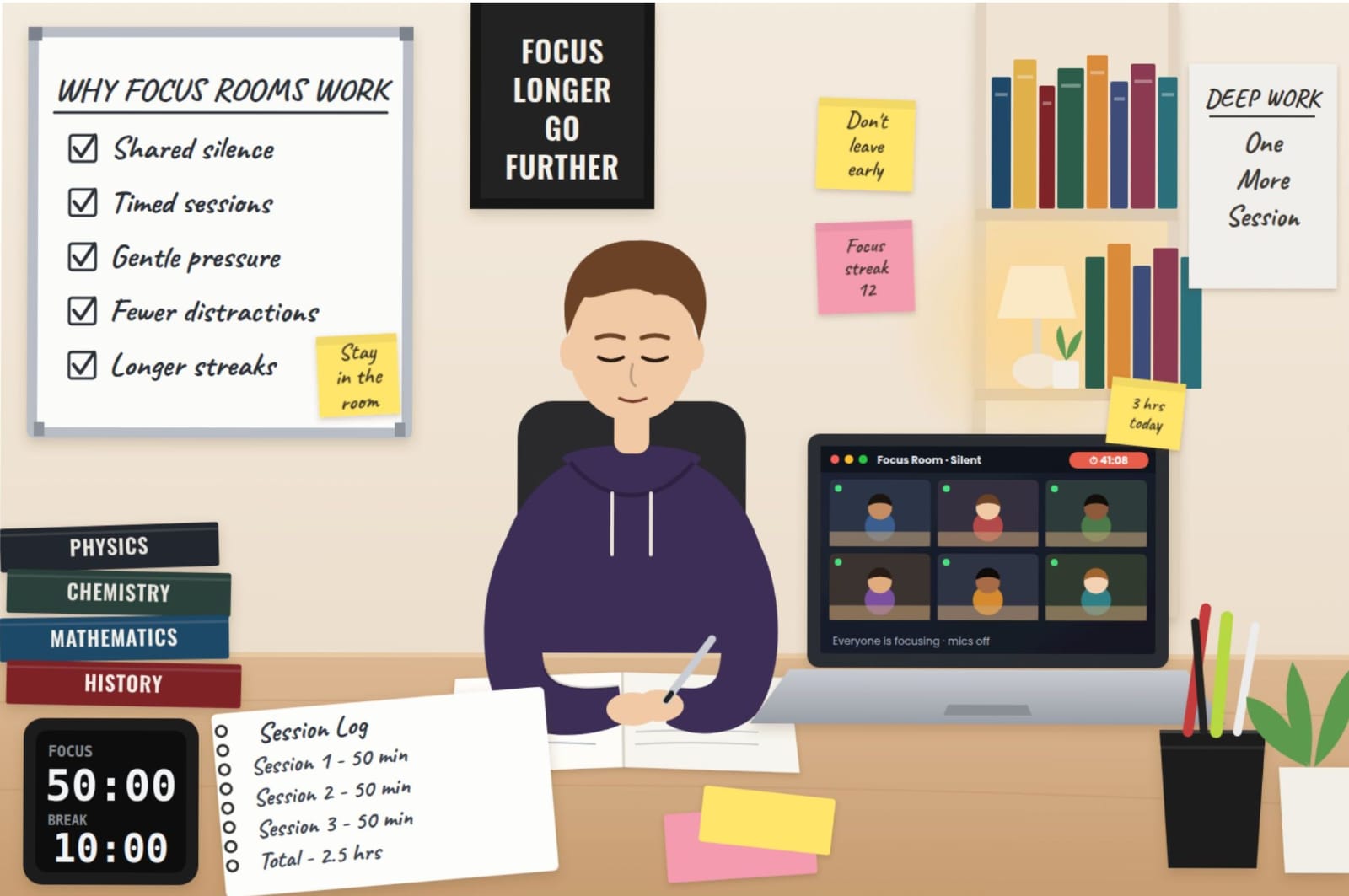
Discover how focus rooms help you study longer by eliminating distractions, improving concentration, and creating the perfect environment for deep learning. Learn how dedicated study spaces, accountability, and effective study habits can boost productivity, enhance focus, and improve academic performance.
The Problem With Studying Everywhere Else
Open a laptop at home and within minutes something pulls you away — a notification, a roommate, the fridge, the noise from the street. Studying in the wrong environment doesn't just slow you down; it quietly trains your brain to associate "study time" with interruption. Focus rooms exist to break that pattern. They are purpose-built spaces designed around one goal: helping you concentrate for longer, retain more, and get more done in less time. This guide breaks down how focus rooms work, what role study partners play inside them, why they're worth joining, and how they stack up against self-study and online study.
How Focus Rooms Help You Study Better

A Space Designed to Remove Distractions
The core advantage of a focus room is environmental control. Soundproofed walls, controlled lighting, and a layout with no visual clutter all reduce the number of things competing for your attention. When your surroundings stop pulling at your senses, your working memory has more room to hold onto what you're actually trying to learn.
Built-In Tools That Keep You Working
Good focus rooms remove the small frictions that break concentration — a dead laptop battery, patchy Wi-Fi, no surface to sketch out a problem on. Reliable power, strong internet, and a clean desk setup mean you spend your study session studying, not troubleshooting.
The Psychology of a Dedicated Study Space
There's a well-documented link between environment and behavior: rooms that are used for one purpose start to trigger that behavior automatically. Walk into a focus room enough times and your brain starts associating the space itself with concentration, making it easier to drop into a focused state faster each time.
Read Also: Understanding Your Brain: What Happens in Our Brains When We Learn?
The Role of Study Partners in a Focus Room
Focus rooms are often thought of as solitary spaces, but study partners can still add real value
— if the dynamic is right.
Structured Collaboration Beats Casual Group Study
The difference between a focus room and a typical study group is intention. In a focus room, any interaction with a study partner tends to be short and specific: clarifying a concept, checking an answer, or working through a sticking point together. The room's culture keeps chatting to a minimum, so partnerships stay productive instead of turning into a social hangout.
What Makes a Good Study Partner
Not every study partner is a good fit for a focused environment. Look for someone who:
● Respects quiet, heads-down time
● Comes prepared with specific questions or goals
● Is comfortable working independently for stretches
● Uses shared time efficiently rather than filling it with conversation
A well-matched study partner can push your understanding further without derailing your concentration.
Why You Should Join a Focus Room

join focus room
Longer, Deeper Study Sessions
Distraction-free time compounds. Ten minutes of uninterrupted focus is worth far more than an hour split across a dozen interruptions, because your brain needs time to get back into deep concentration after every break. Focus rooms are built to protect that uninterrupted stretch, which is exactly what's needed for genuinely difficult material.
Better Time Management
Booking a focus room session — often for a set block of time — naturally pushes you toward planning. Knowing you only have, say, 90 distraction-free minutes encourages you to walk in with a clear goal instead of drifting through your notes aimlessly.
A Clear Mental Boundary Between "Relaxing" and "Working"
One underrated benefit is separation. Studying in your bedroom means your brain has to work hard to distinguish "relax here" from "focus here," using the same four walls for both. A focus room removes that conflict entirely — the moment you sit down, your mind already knows what mode it's supposed to be in.
Access to a Focused Community
Being surrounded by other people who are also working with intent has a subtle but real effect. It's harder to open a distracting tab or scroll your phone when everyone around you is visibly deep in concentration — a kind of quiet peer accountability that's hard to replicate studying alone at home.
Self-Study vs. Online Study: Where Focus Rooms Fit In
Self-study and online study solve different problems, and focus rooms can strengthen both — just in different ways.
Self-Study: Depth Through Solitude
Self-study relies on your ability to work through material entirely on your own — reading, practicing problems, and reviewing notes without outside input. This is where focus rooms shine most obviously: the controlled, distraction-free setting gives your independent work the uninterrupted runway it needs.
Online Study: Flexibility That Needs Structure
Online courses offer flexibility that self-study alone can't — structured lessons, video content, and scheduled deadlines. But that same flexibility is exactly what makes online learning vulnerable to distraction; it's easy to half-watch a lecture while doing something else. Taking online classes from inside a focus room fixes this weak point, pairing the structure of the course with an environment that forces genuine attention.
Read Also: Virtual Study Rooms vs Traditional Study Methods: A Complete Comparison
Which One Should You Choose?
The honest answer is that it's not really a competition. Self-study builds independent thinking; online study provides structure and content delivery. A focus room isn't a replacement for either
— it's the environment that lets both approaches actually work as intended, instead of being undermined by a noisy, distracting setting.
Read Also:- How to Build a Consistent Study Routine Using an Online Focus Room
Frequently Asked Questions
1. What is a focus room, exactly?
A focus room is a dedicated space — soundproofed, well-lit, and free of clutter — designed specifically to support concentrated study or work. Unlike a regular room at home or a busy café, it's built to remove distractions rather than just offer a place to sit.
2. Can I use a focus room with a study partner, or is it only for solo study?
Both work well. Focus rooms are ideal for solo, deep-concentration sessions, but they also support short, purposeful collaboration with a study partner — as long as the interaction stays focused and doesn't turn into a casual conversation.
3. Are focus rooms better than studying online at home?
They serve different needs. Online study gives you structure and flexible content, while a focus room gives you an environment built for concentration. Using a focus room for your online classes combines both, so you get structured content without the usual at-home distractions.
4. How long should a typical focus room session last?
There's no fixed rule, but many people find 60–90 minute blocks effective, since this is usually long enough to enter deep concentration without hitting mental fatigue. You can always book back-to-back sessions with short breaks in between for longer study days.
Make Your Environment Work For You
Focus rooms aren't a gimmick — they're a practical response to a genuine problem: most environments are built for everything except deep concentration. By minimizing distractions, supporting smart collaboration with study partners, and giving both self-study and online study a real chance to succeed, focus rooms help you study longer and retain more of what you learn. If your current study spot keeps letting you down, it might be time to change the room, not just the routine.