Focus
The 2357 Method: A Smarter Study Technique to Improve Focus, Memory & Exam Performance
StudyMates TeamJul 17, 2026
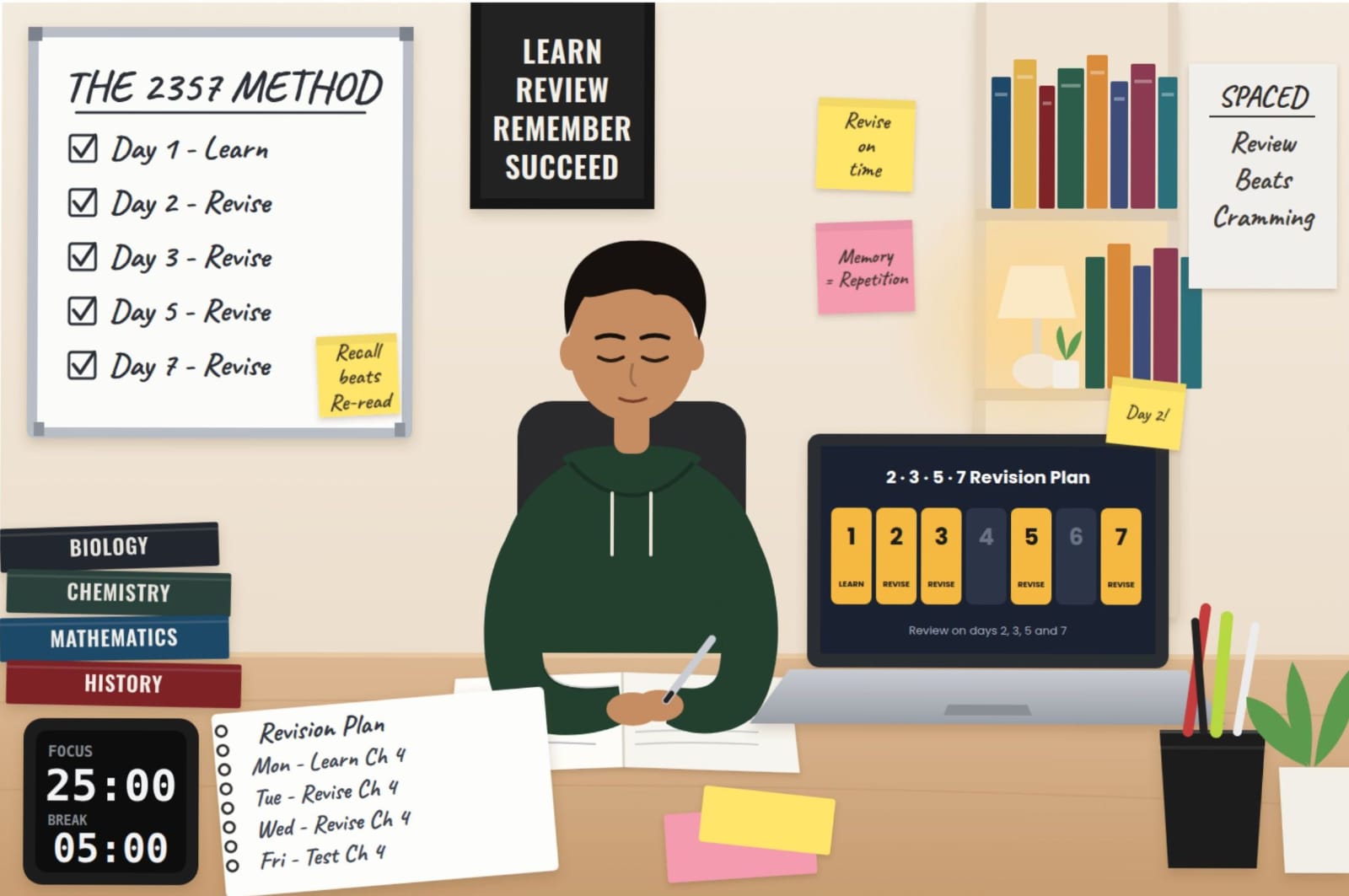
The 2357 Method is a simple study technique that uses spaced revision on Days 2, 3, 5, and 7 to improve memory, focus, and long-term retention. It's ideal for students preparing for exams and competitive tests.
Studying for longer doesn't automatically mean learning better. What predicts retention far more reliably is when you review material, not just how many hours you put in. Millions of students spend hundreds of hours preparing for exams and still struggle to recall what they studied a few days earlier — not because they didn't understand it, but because the brain forgets information on a predictable schedule unless it's reviewed at the right intervals. The 2357 Method is a simple revision framework built around that idea. This guide covers what it is, the research it's based on, how to run it week to week, and where it can go wrong.
Read this blog also: - Why Focus Rooms Help You Study Longer
Why Students Forget What They Study
Most "bad memory" complaints trace back to study habits, not memory capacity:
Benefits of the 2357 Method
Benefit
Step 3 — Day 3 revision. Test yourself with practice questions or flashcards. Active recall matters more here than passive review.
Step 4 — Day 5 revision. Solve related problems, write a short summary from memory, or explain the topic aloud as if teaching someone else.
Step 5 — Day 7 revision. Do a final pass over your notes and attempt a short self-quiz.
Repeat the cycle for each new topic, ideally overlapping cycles for different chapters so you always have a mix of new material and scheduled reviews running at once.Pair It With Active Recall
The 2357 Method gets meaningfully stronger when each session uses active recall instead of rereading. Before checking your notes, ask:Studying Consistently: Environment Matters Too
A revision schedule only works if you actually sit down and follow it. Many students who understand spaced repetition still fall off the schedule because they're studying alone and get pulled off track by notifications or isolation. Some students find that a structured, low-distraction environment — a library, a study group, or a virtual co-working/study-room platform such as Studymates.Live, Focusmate-style tools, or moderated study servers — makes it easier to actually show up for Day 2, Day 3, Day 5, and Day 7 sessions rather than skip them. The schedule matters more than the venue, but the venue affects whether you keep the schedule.
Common Mistakes to Avoid
 Skipping revision days — the intervals are the mechanism; skipping them undercuts the method.Passive rereading — rereading notes isn't the same as retrieving them from memory.Overloading each session — cap the number of topics per day to something you can actually revisit properly.Ignoring weak areas — give harder topics extra sessions rather than treating every topic equally.Cutting sleep — memory consolidation happens during sleep; 7–9 hours matters as much as the revision schedule itself.
Read this blog also: - Body Doubling for Students: The Science Behind Studying Better With Others
Does Research back the 2357 Method?
To be direct about the limits of this claim: the specific "Day 2, 3, 5, 7" schedule has not itself been tested as a named protocol in peer-reviewed research. What is well supported is the underlying science it's built from — the Ebbinghaus forgetting curve, spaced/distributed practice, and retrieval practice, all of which Dunlosky et al. (2013) rank among the most effective, evidence-backed study techniques available. The 2357 Method is best understood as a practical, easy-to-remember schedule for applying that research, not as a separately validated method in its own right.
Frequently Asked Questions
What Is the 2357 Method?
The 2357 Method is a revision schedule where you revisit newly learned material on specific days after you first study it:- Day 2
- Day 3
- Day 5
- Day 7
Note on variants: You'll also see a version of this technique (used by some UK universities' study-skills guides) that counts backward from an exam date instead — scheduling sessions 7, 5, 3, and 2 days before the test. Both are legitimate applications of the same underlying spacing principle; this guide uses the forward-counting version, which is more common for ongoing coursework rather than single-exam cramming.
Why the 2357 Method Works: The Research Behind It
The 2357 Method isn't itself a peer-reviewed protocol — it's a practical scheduling framework built on top of learning science that is well established. Two ideas do the actual work:1. The forgetting curve. In 1885, German psychologist Hermann Ebbinghaus documented that people forget a large share of newly learned information within days if it isn't reviewed — and that each review measurably slows the rate of further forgetting. 2. Spaced (distributed) practice. In a major review of ten common study techniques, cognitive psychologists John Dunlosky, Katherine Rawson, Elizabeth Marsh, Mitchell Nathan, and Daniel Willingham found that distributed practice and practice testing (active recall) were the two most effective, best-evidenced techniques for improving learning across subjects and age groups — well ahead of habits like highlighting or rereading, which they found showed little benefit (Dunlosky et al., Psychological Science in the Public Interest, 2013). The 2357 Method is essentially a concrete, easy-to-follow schedule for applying both principles at once: it spaces your reviews and, if you use active recall during each session (see below), it layers in retrieval practice too.Read this blog also: - Why Focus Rooms Help You Study Longer
What Happens in Your Memory at Each Stage
First study session — you understand the concept, but the memory is still fragile.- Day 2 — the first review reinforces the memory before it fades much.
- Day 3 — recall starts to require less effort.
- Day 5 — connections between related ideas strengthen.
- Day 7 — the memory becomes noticeably more stable, improving the odds of long-term retention.
Why Students Forget What They Study
Most "bad memory" complaints trace back to study habits, not memory capacity:- Passive rereading instead of active recall
- highlighting everything instead of identifying key ideas
- cramming shortly before exams
- Little or no spaced revision.
- Long, unbroken study sessions with no breaks.
- Constant phone or notification interruptions.
- poor or inconsistent sleep
Benefits of the 2357 Method

Benefit
- Stronger long-term recall
- less last-minute stress
- Better consistency,
- Time efficiency
- More confidence
How to Use the 2357 Method
Step 1 — Learn the topic. Focus on understanding the concept, not memorizing every line. Take concise notes and flag the key points. Step 2 — Day 2 revision (15–20 min). Try to recall the material from memory before rereading your notes.Step 3 — Day 3 revision. Test yourself with practice questions or flashcards. Active recall matters more here than passive review.
Step 4 — Day 5 revision. Solve related problems, write a short summary from memory, or explain the topic aloud as if teaching someone else.
Step 5 — Day 7 revision. Do a final pass over your notes and attempt a short self-quiz.
Repeat the cycle for each new topic, ideally overlapping cycles for different chapters so you always have a mix of new material and scheduled reviews running at once.
Pair It With Active Recall
The 2357 Method gets meaningfully stronger when each session uses active recall instead of rereading. Before checking your notes, ask:- What are the main concepts, in my own words?
- Can I explain this without looking?
- What formulas or definitions can I write from memory?
- Can I solve a related problem unaided?
Studying Consistently: Environment Matters Too
A revision schedule only works if you actually sit down and follow it. Many students who understand spaced repetition still fall off the schedule because they're studying alone and get pulled off track by notifications or isolation. Some students find that a structured, low-distraction environment — a library, a study group, or a virtual co-working/study-room platform such as Studymates.Live, Focusmate-style tools, or moderated study servers — makes it easier to actually show up for Day 2, Day 3, Day 5, and Day 7 sessions rather than skip them. The schedule matters more than the venue, but the venue affects whether you keep the schedule.
Common Mistakes to Avoid
Skipping revision days — the intervals are the mechanism; skipping them undercuts the method.Passive rereading — rereading notes isn't the same as retrieving them from memory.Overloading each session — cap the number of topics per day to something you can actually revisit properly.Ignoring weak areas — give harder topics extra sessions rather than treating every topic equally.Cutting sleep — memory consolidation happens during sleep; 7–9 hours matters as much as the revision schedule itself.Read this blog also: - Body Doubling for Students: The Science Behind Studying Better With Others
Who Should Use the 2357 Method
Well suited to:- UPSC, SSC, banking, and other long-duration competitive exam aspirants
- NEET and JEE students
- CA and professional-certification candidates
- School and college students with ongoing coursework
- Language learners