Active Recall Study Method: How It Works
Learn how the active recall study method works, how to use it with notes and questions, and how to build it into your daily study routine.
Reading your notes again and again can feel productive, but recognizing information on a page is not the same as remembering it without help.
When you study for an exam, you often need to retrieve information when your notes and textbook are not in front of you. This is where active recall can become a useful part of your study routine.
Active recall means deliberately trying to remember information instead of simply looking at it. You ask yourself questions, answer them from memory, and then check your answer.
In this guide, you will learn what active recall is, how to use it, which techniques can help, and how to combine it with your existing study routine.
What Is Active Recall?
Active recall is a study method where you actively retrieve information from memory instead of repeatedly reading the material.
For example, imagine you have just studied a chapter about photosynthesis. With passive studying, you might read the chapter several times or highlight important sentences.
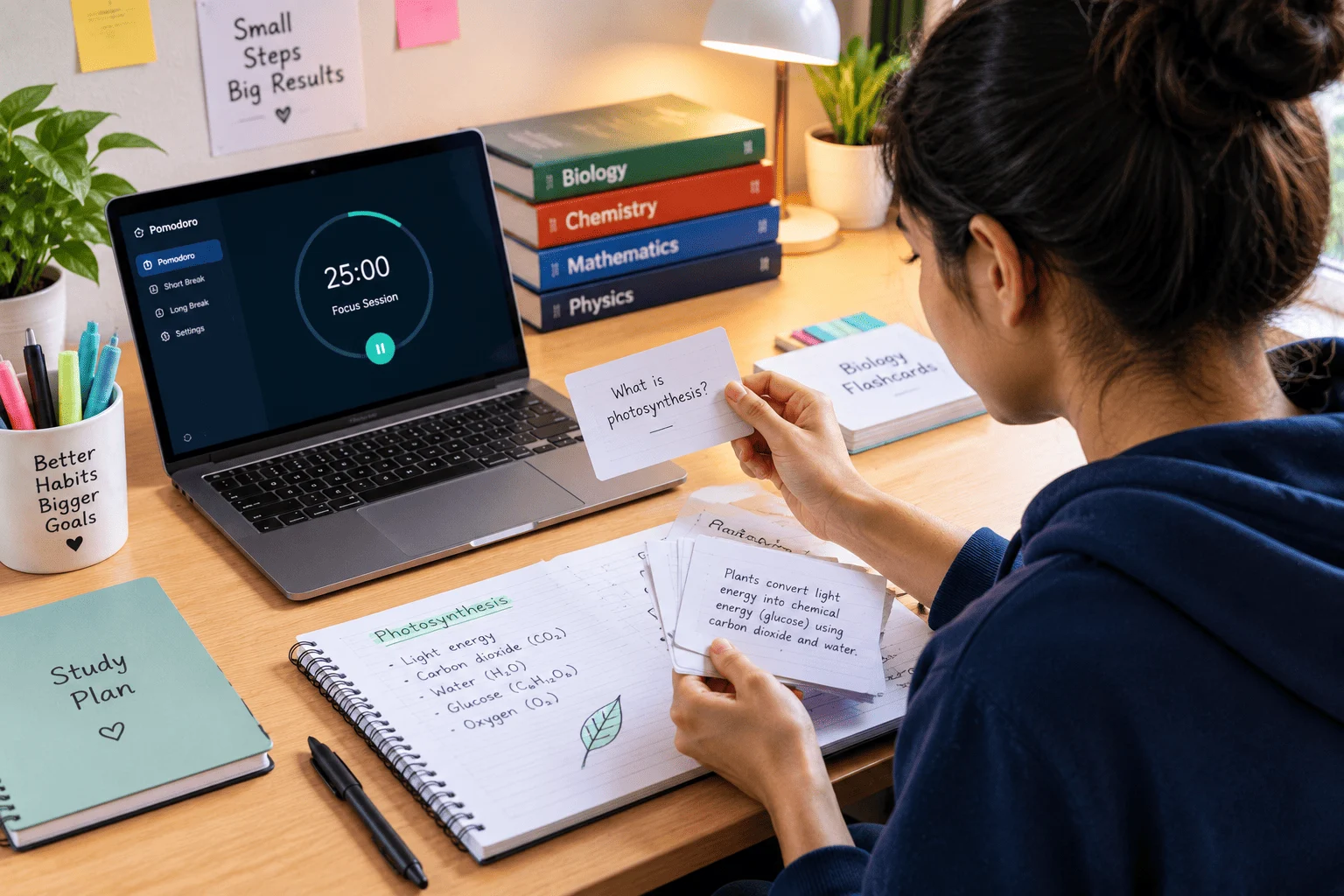
With active recall, you close the book and ask yourself questions such as “What is photosynthesis?” or “What are the main stages involved?” You then try to answer without looking at the material.
After answering, you check your notes to see what you remembered correctly and what you missed.
The important part is the attempt to retrieve the information before checking the answer.
Active Recall vs. Rereading
Rereading can help you become familiar with information, but it does not always tell you whether you can remember that information independently.
Active recall changes the direction of studying. Instead of repeatedly putting information into your mind, you practice bringing information back out.
For example, consider a history chapter containing several important dates and events.
Instead of reading the dates repeatedly, close your notes and try to write down the events and dates you remember. Then compare your answer with your notes.
This gives you immediate feedback about which parts you know and which parts need more attention.
Why Is Active Recall Useful for Studying?
One useful feature of active recall is that it makes studying more interactive. You are not simply looking at information. You are doing something with it.
It can also help you identify gaps in your understanding. When you cannot answer a question, you have a clear signal that the topic needs another look.
This can make your study sessions more targeted. Instead of spending the same amount of time reviewing everything, you can give more attention to the topics you are struggling to retrieve.
Active recall can also fit into many different study methods. You can use questions, flashcards, practice tests, blank-page exercises, or simply explain a topic from memory.
How to Use Active Recall With Your Notes
You do not need to completely change the way you take notes. You can add active recall after you finish learning a section.
Start by studying a small amount of material. Read the section carefully and make sure you understand the basic ideas.
Then close your notebook or textbook.
Ask yourself what you remember. You can write down key ideas, explain the topic aloud, or answer questions without looking at the source.
Afterward, open your notes and compare your response with the original material.
Repeat this process for the areas you could not remember clearly.
Use Questions Instead of Just Highlights
Questions are one of the simplest ways to turn ordinary notes into active recall practice.
Suppose your notes say that the heart has four chambers. Instead of only highlighting that sentence, turn it into a question:
“How many chambers does the human heart have, and what are they called?”
You can then hide the answer and try to retrieve it.
For a larger topic, create several questions that test different parts of the material. Use simple questions for facts and deeper questions for concepts that require explanation.
Try the Blank-Page Method
The blank-page method is another simple form of active recall.
Take a blank sheet of paper and write the name of the topic at the top. Without looking at your notes, write everything you can remember about that topic.
Do not worry about making the first attempt perfect. The purpose is to find out what you can retrieve.
When you finish, compare your page with your notes. Mark the important points you missed or remembered incorrectly.
You can then review those areas and repeat the exercise later.
Use Flashcards for Active Recall
Flashcards can work well when they require you to produce an answer before revealing it.
Put a question or prompt on one side and the answer on the other. Look at the question first and try to answer from memory.
Only reveal the answer after you have made an attempt.
For example, a biology flashcard might ask, “What is the function of the mitochondria?” You should try to answer before checking the other side.
Avoid putting too much information on one card. A clear question with a focused answer is easier to practice repeatedly.
Use Practice Questions and Tests
Practice questions are a natural form of active recall because they require you to retrieve information and produce an answer.
After studying a topic, try answering questions without checking your notes first.
If you are preparing for an exam, practice questions can also help you become familiar with the type of thinking required by the subject.
When you get an answer wrong, do not simply memorize the correct response and move on. Look at why your answer was incomplete or incorrect, then try a similar question again later.
Explain the Topic Without Looking
Another way to use active recall is to explain a topic in your own words.
Close your textbook and imagine that you are teaching the topic to someone who has never studied it before.
Explain the main idea, important terms, steps, examples, and connections you remember.
If you get stuck, make a note of the missing part and check your study material afterward.
This technique can be especially useful for subjects where understanding matters more than memorizing isolated facts.
Do Not Check the Answer Too Quickly
One common mistake is looking at the answer as soon as a question becomes difficult.
Give yourself enough time to make a genuine attempt. Even if you remember only part of the answer, that attempt is useful for identifying what you know and what you need to review.
However, active recall should not become frustrating. If you genuinely cannot remember something after a reasonable attempt, check your notes, understand the answer, and try again later.
Combine Active Recall With Spaced Study
Active recall does not have to happen only once.
You can return to questions and topics at different points in your study routine. This gives you multiple opportunities to retrieve information rather than relying on one long review session.
For example, after learning a topic, test yourself later that day. Return to it during another study session and test yourself again.
You can also combine active recall with a structured study timer. The Pomodoro technique for studying can help you create focused sessions where part of the time is dedicated to self-testing.
How to Build an Active Recall Study Session
A simple active recall session can follow a repeatable structure.
- Choose one topic you want to study.
- Review the material carefully enough to understand the main ideas.
- Close your notes or textbook.
- Write questions or prompts about the material.
- Answer the questions from memory.
- Check your answers against your study material.
- Mark the information you could not remember.
- Review the weak areas and test yourself again later.
You do not need to use every active recall technique in one session. Choose the method that fits the subject and the type of information you are learning.
Common Active Recall Mistakes
Reading the Answer Before Trying
If you look at the answer immediately, you are mainly reviewing rather than testing your memory. Make an honest attempt before checking.
Making Questions Too Easy
Questions should require you to remember something. If the answer is obvious from the wording of the question, rewrite it to make the retrieval task more meaningful.
Testing Only Once
One successful answer does not mean you never need to revisit the topic. Return to important material and test yourself again.
Focusing Only on Facts
Active recall can be used for concepts and explanations too. Ask yourself to explain why something happens, compare two ideas, or describe a process in your own words.
Ignoring Mistakes
Incorrect answers are useful information. Pay attention to what you missed and use those mistakes to guide your next review.
Active Recall for Different Subjects
Science
Use questions about definitions, processes, diagrams, formulas, and explanations. Try explaining a process without looking at your textbook.
Math
Try solving problems without immediately checking the worked solution. If you make a mistake, identify the step where your reasoning changed and try another problem.
History
Test yourself on people, events, dates, causes, effects, and connections between events. Try explaining an event without referring to your notes.
Languages
Use flashcards and self-testing for vocabulary, grammar rules, meanings, and sentence construction. Try producing the answer rather than simply recognizing it.
Make Active Recall Part of Your Routine
Active recall becomes easier when you make it a normal part of studying.
Instead of spending an entire session rereading notes, divide your time between learning, recalling, checking, and reviewing.
You can also keep a list of questions for each subject. When you sit down to study, use those questions to begin testing yourself.
If you often struggle to start studying, breaking your session into clear tasks can also help. You can read How to Focus While Studying Without Getting Distracted for practical ways to create a better study environment.
For students who prefer studying alongside others, StudyMates provides online study rooms where you can work alongside other people while completing your own study tasks. You can explore the StudyMates study rooms when you want a more structured study environment.
Do not just look at what you know; close the notes and find out what you can actually remember.
Frequently Asked Questions
What is active recall in studying?
Active recall is a study method where you deliberately retrieve information from memory instead of simply rereading it. You can use questions, flashcards, practice tests, or explanations from memory.
Is active recall better than rereading?
Active recall and rereading serve different purposes, but active recall gives you a way to test whether you can retrieve information without looking at your notes. It can therefore make gaps in your knowledge easier to identify.
How do I start active recall?
Start with a small topic and study it first. Then close your notes and write or say everything you can remember before checking the material.
Can I use active recall with flashcards?
Yes. Flashcards can be used for active recall when you try to answer the question before revealing the answer. Keep each card focused on one clear piece of information or concept.
How often should I use active recall?
You can include active recall throughout your study routine rather than using it only before an exam. Return to important topics and test yourself again as part of your regular revision.